Prerequisites: None.
The advent of Generative AI has now added a new layer of complexity for Java engineers. They must understand how to assimilate this critical innovation into their development workflows where it makes sense. This integration introduces a powerful and transformative dimension to the overall software development process.
Why Generative AI Matters in Java Development
Before integrating Generative AI into their software development process, Java developers need to understand the foundations of generative AI. These foundational concepts include Artificial Intelligence, Machine Learning, Deep Learning, Predictive AI, and Generative AI, which all Java software engineers must first understand.
Artificial Intelligence (AI), simply put, is the simulation of human intelligence in machines that are programmed to think and learn like humans. AI uses algorithms and specialized hardware to enable machines to perform tasks that typically require human intelligence. These tasks include problem-solving, learning, perception, language understanding, and decision-making. AI is not a new technology; it has a history that goes back many decades, at least to the 1940s and 1950s. With the advent of cloud computing with instantly available computing resources, AI capabilities are now easily accessible to all developers.
Machine Learning (ML) is one subset of AI. It is a broader concept that involves the development of algorithms and statistical models that enable a system to perform a specific task without being programmed using conventional techniques. The machine ingests large quantities of data and determines patterns from this data. This is similar to mathematical algorithms that determine formalized functions from a given dataset, a technique that I’m sure many of us learned during numerical analysis classes during our university education.
A popular subset of ML is Deep Learning (DL). This type of machine learning typically uses a combination of data structure and algorithm called a neural network. A neural network is a cascading set of probabilistic weights determined by reading large quantities of historical data patterns. This data can be based on text, images, sound, or other types. The more layers in the neural network, the greater the accuracy (and complexity) of the machine learning model. Each additional layer that processes the input data increases the model’s ability to recognize patterns in the data. Along with the availability of significant cloud computing resources, deep learning attempts to simulate the human brain’s architecture to process data and make decisions. Of course, with more layers to obtain more accuracy, additional and substantial computational resources are required. A commonly forgotten aspect of this enhanced accuracy is the resultant financial and environmental impacts.
ML is a broad concept encompassing various techniques for task-specific learning. Deep learning, on the other hand, is a more sophisticated and specific type of machine learning that involves neural networks with multiple layers to learn data patterns. In the general trade press, it’s important to note that the term “machine learning” is more commonly used, even though the more accurate term is “deep learning.”
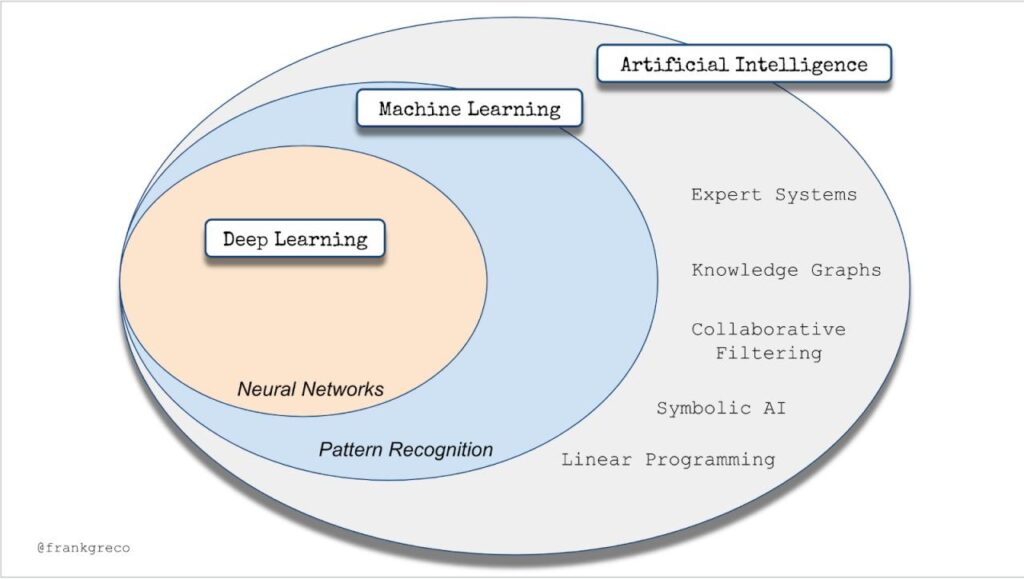
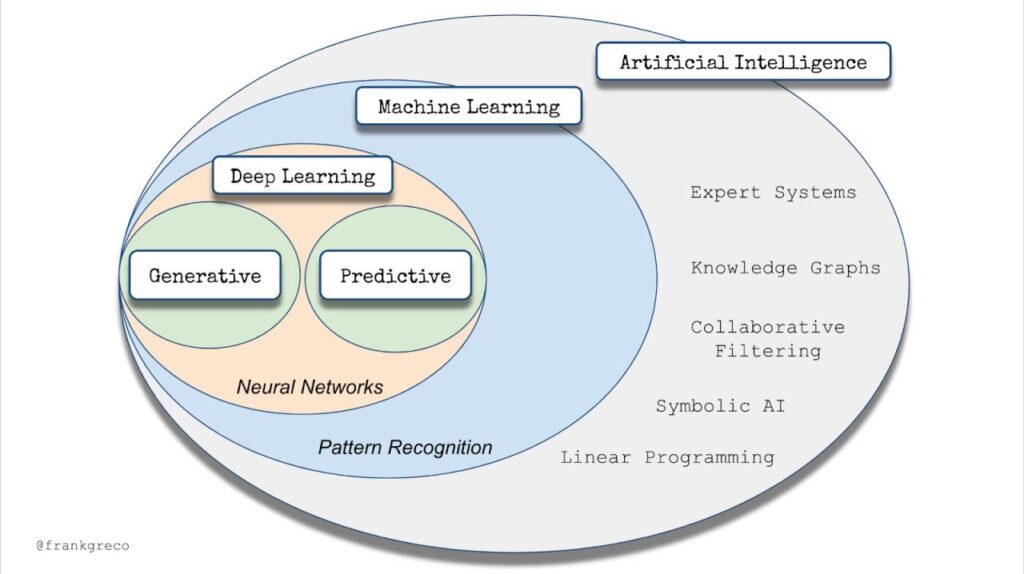
Within Deep Learning, there are two primary and important subsets: Predictive AI and Generative AI.
Predictive AI focuses on making predictions or forecasts based on historical data. It aims to identify patterns in the data and use them to predict future outcomes. Predictive AI models are trained on labeled datasets, where the algorithm learns the relationships between input features and the corresponding target variable. Predictive AI is particularly useful when there is a need to anticipate specific outcomes based on available data. Weather prediction, image classification, recommendation systems, autonomous vehicles, anticipating hardware/software failures, detecting email anomalies, etc, are examples of predictive AI. For many use cases, Predictive AI is an excellent technique to use and has been successfully deployed in production for at least the past 10 to 15 years. There are several excellent Java toolkits for Predictive AI, such as JSR 381 Visual Recognition, Amazon’s DLJ, and Deep Netts.
Another very important subset of Deep Learning is Generative AI or “GenAI”. This is the type of AI that the world is currently excited about. GenAI focuses on creating new data samples that resemble the input data it was trained on. Instead of predicting from existing data, GenAI generates novel, synthetic data based on learned patterns. Generative AI is currently extremely popular for its ability to create human-like text, images, and sound. Generative AI typically deals with a type of Natural Language Processing (NLP) that uses an architecture called “Transformers,” which was developed at Google in 2017. These systems use Large Language Models (LLMs) that are trained on large quantities of text to extract patterns. While there are popular LLMs available from large companies such as OpenAI, Google, and Microsoft, there currently are many thousands of open-source models that you can run directly on your laptop. The growing popularity of these open-source LLMs is a significant trend to monitor.
In summary, predictive AI is centered around making predictions based on existing patterns, while generative AI is focused on creating new, realistic data. Both approaches have their own set of applications and are valuable in different contexts within the field of artificial intelligence. There are even use cases that combine both types of deep learning. We will focus here on generative AI, which is currently a very popular topic in the industry.
Effective Communication with Generative AI
We certainly know that Generative AI is a groundbreaking field that has evolved rapidly, offering incredible potential for creativity and problem-solving. Communicating effectively with these models is critical and involves mastering the art of prompt engineering.
At the core of interacting with generative AI is the concept of prompts and completions. A prompt is the input provided to the model, guiding it to generate relevant and coherent outputs. Those outputs returning from the LLM are called completions. The LLM effectively says, “I will use your prompt starting point and complete a string of words based on the most probable ones that I have learned.”
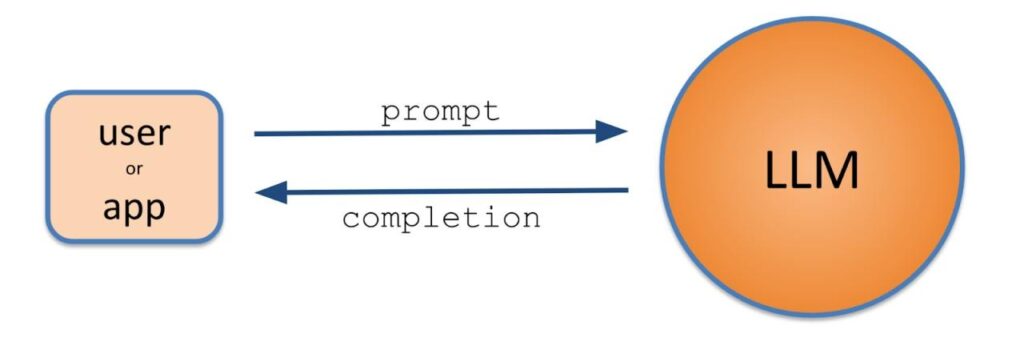
Understanding the relationship between prompts and completions is key to getting an LLM to generate the desired result. Crafting prompts with precision is vital for obtaining desired and meaningful completions.
Importance of Effective Prompts
The quality of prompts significantly influences the output of generative AI. Well-crafted prompts lead to more accurate and contextually relevant responses. Clear and specific prompts enhance the model’s understanding of the user’s intent, resulting in more satisfactory outcomes.
- Clarity and Specificity: Clearly articulate your request. Ambiguous prompts may lead to unexpected or undesired results. Specify the format or type of response you seek.
- Contextual Information: Provide relevant context within your prompt. This helps the model understand the nuances and generate responses that align with your expectations.
- Length and Detail: Experiment with the length of the prompts. Sometimes, concise prompts work best, while other situations may require more detailed and lengthy instructions. Test and iterate to find the optimal balance.
OpenAI and GenAI Services
There are several very large companies offering GenAI services, such as OpenAI, Google, Anthropic, Cohere, Meta, Hugging Face, etc. Many of the fundamental services from these companies are similar. Thanks to the popularity of its chatbot application “ChatGPT”, OpenAI and its service offerings are certainly among the leaders in the industry.
Two prominent platforms for interacting with OpenAI’s generative models are ChatGPT and Playground. Both use the OpenAI stateless APIs. ChatGPT is a chat web application that maintains a history of the conversation with the user to maintain a sense of context, which improves the model’s response. ChatGPT is designed for more interactive and dynamic conversations, making it suitable for various applications, including code generation, debugging, explanations, unit test generation, and general ideation. On the other hand, Playground provides a more controlled environment for experimenting with model inputs and observing outputs. Playground is similar to other web-based tools that allow you to experiment with REST APIs. You can take the lessons learned from Playground experiments and use them in your Java software.
Since the OpenAI APIs are essentially REST APIs, it’s relatively straightforward to write Java code to access them. We must also add timeouts, retries, efficient I/O, parsing URLs, and error handling. It’s not hard, but as senior Java developers, our first instinct is to search for a library with these features. Thankfully, OpenAI has a list of some good community-built libraries. The Java API from Theo Kanning is a good one to use.
Mastering prompt engineering is the gateway to unlocking the full potential of generative AI. By understanding the nuances of prompts, appreciating the impact of well-crafted inputs, and exploring practical examples, users can harness the capabilities of these powerful models to enhance creativity, problem-solving, and interactive experiences.
Crafting a Private Chatbot Architecture in Java
Building a private chatbot using Java-centric tools can be rewarding, leveraging the power of Generative AI to create intelligent and interactive conversational agents. We’ll focus on OpenAI’s API and services, but all the language models from the various companies and open-source versions are functionally similar.
OpenAI’s ChatGPT, powered by the GPT architecture, offers a versatile platform for natural language processing. The Playground provides developers with a testing ground to experiment with the model’s capabilities. Through OpenAI’s REST APIs, Java developers can seamlessly integrate ChatGPT into their applications.
However, ChatGPT is trained on general web information and, typically, has no knowledge of your own documentation and other resources. While you can fine-tune the existing OpenAI language models, it typically requires data science expertise, carefully curated data sets, and a significant amount of computing resources and expense.
Retrieval Augmented Generation
Retrieval Augmented Generation (RAG) is a cost-effective and popular method for enhancing how a language model, like those developed by OpenAI, understands a specific set of documentation. Introduced by Facebook AI Research in 2020, RAG is known for its surprising accuracy and operates by combining generative and retrieval-based techniques. It utilizes a vector database, designed for efficient storage and quick retrieval of text data in the form of embedding vectors (an array of floating point numbers). This method improves the chatbot’s response quality by making them more relevant and coherent, reducing the occurrence of incorrect responses, often called “hallucinations”. Developers, especially those familiar with Java, can leverage RAG to enhance the functionality of their chatbots. A deep understanding of RAG’s complexities is crucial for maximizing the benefits of advanced language models. While a very popular GenAI prompt technique, RAG has some downsides, particularly consistency and cost. You are potentially sending large, ever-growing chunks of relevant text back and forth, increasing your costs.
Crafting a private chatbot architecture in Java involves integrating OpenAI’s ChatGPT with Java-centric tools and implementing RAG techniques. This is done by navigating vector databases and text-similarity algorithms, which are crucial for enhancing retrieval capabilities. Following this pattern as a guide and utilizing Java’s robust ecosystem, developers can build and deploy intelligent chatbots that understand local and private information, such as private corporate resources.
Responsible AI
Since AI/ML is an extremely powerful tool, Java developers venturing into this domain must prioritize ethics, security, privacy, and responsible AI practices. These considerations go beyond coding proficiency and are crucial for ensuring the responsible deployment of AI technologies.
Responsible AI development involves addressing the broader societal impact of AI applications. Java developers should be mindful of the potential consequences of their creations on employment, social structures, and the environment. Striking a balance between innovation and responsibility ensures that AI contributes positively to society without causing harm or exacerbating existing inequalities.
Java developers entering the field of AI should also be cognizant of bias and fairness issues. AI models can inadvertently perpetuate biases present in training data. Developers must actively work to identify and mitigate biases, employing techniques such as fairness-aware machine learning and continuous monitoring to rectify any unintended disparities.
Ethics, security, privacy, and responsible AI practices are integral components of a Java developer’s skill set when venturing into the world of AI. Beyond mastering algorithms and coding, developers must champion ethical considerations, implement robust security measures, prioritize privacy, and ensure responsible AI deployment. By embracing these principles, Java developers contribute to building AI systems that are not only technically proficient but also ethically sound and socially responsible.
Java Developers Must Understand AI/ML
AI/ML systems are a long-term trend not only for the IT industry but for everyone. They will affect people, companies, enterprises, countries, economies, and civilization. Used responsibly, this technology will provide many benefits. Java developers must understand how to properly use AI/ML in their everyday workflow. Java developers without this knowledge will be at a significant disadvantage.
I know many Java developers are busy with their day jobs handling production deployments. This was a high-level introduction to the basic concepts. I plan on giving a full course on the basic concepts, including complete code examples, so that the Java community fully understands the foundations of this new and very different type of IT tool. GenAI is starting to enter production deployments with many organizations around the world. Production deployment is where Java shines.
